Showing posts with label Biodiversity conservation. Show all posts

Tuesday, February 14, 2012

Expedition to Suriname Finds New Species

The crown jewels of earth, in the form of varied biological life, no matter how small or big, form a wealth that no one can recreate. Then, if a scientific expedition of three weeks duration to three remote sites along Kutari and Sipaliwini rivers near village Kwamalasumutu in southwest Suriname yield a documented list of nearly 1300 species, including 46 new species is an achievement that any biologist or a nature lover will appreciate.

Carried under the Rapid Assessment Program (RAP) of the Conservation International, the expedition comprised a collaborative team of 53 scientists, indigenous Trio people, students who documented status of species  which included plants, animals, fishes, reptiles, amphibians, birds, small and large mammals, katydids, dragonflies, damselflies, aquatic beetles and dung beetles. Suriname has the world's last pristine tropical forests. RAP surveys carried by CI provide a quick assessment of the unique biodiversity of an unexplored area.

CI scientist and RAP Director Dr. Trond Larsen said, "Our team was privileged to explore one of the last remaining areas of vast, unroaded wilderness in the world. As a scientist, it is thrilling to study these remote forests where countless new discoveries await, especially since we believe that protecting these landscapes while they remain pristine provides perhaps the greatest opportunity for maintaining globally important biodiversity and the ecosystems people depend upon for generations to come."

The findings of the expedition were recently released for press by CI; the release entitled, "An armoured catfish, a cowboy frog....in southwest Suriname" provides details of  expedition and some interesting species and their pictures which are reproduced below alongwith their links.    
Cowboy Frog (Hypsiboas sp.) was discovered low on a small branch during a night survey in a swampy area of the Koetari River. The main distinguishing characteristic of this frog is the lack of a certain characteristic. It looks quite similar to "the Convict Treefrog" Hypsiboas calcaratus but lacks the black and white lateral stripes of H. calcaratus.


Pac-Man Frog (Ceratophrys cornuta), a voracious sit-and-wait predator, with an exceptionally wide mouth, can swallow prey nearly as large as its own body, including birds, mice and other frogs. One researcher using a radio collar to track birds found her study animal (and collar) in the belly of this frog!

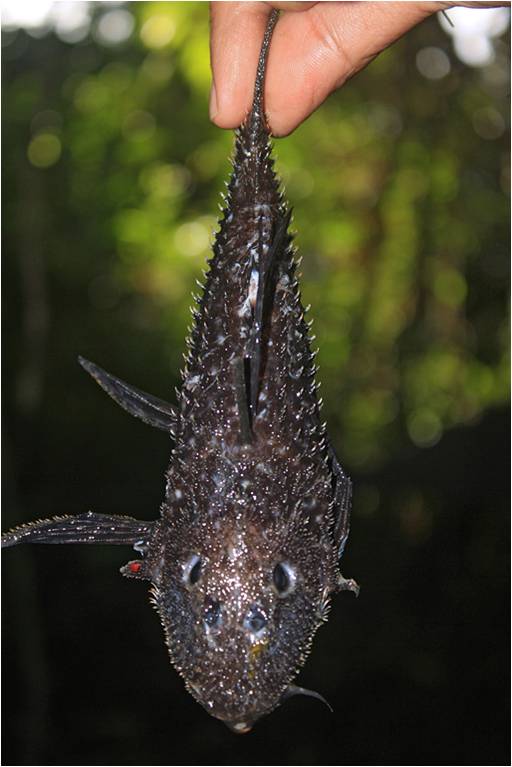
A new species, the Armored Catfish (Pseudacanthicus sp.) is a catfish whose armor of external bony plates is covered with spines to defend itself from giant piranhas which inhabit the same waters. Only a handful of Pseudacanthicus specimens are known from Suriname, and this is the first from the Sipaliwini
  
Crayola Katydid (Vestria sp.) known as Crayola katydids because of their striking coloration. They are the only katydids known to employ chemical defenses, which are effective at repelling bird and mammalian predators.
The Monkey Frog (Phyllomedusa tomoptema) is a species of tree frogs, these frogs are indicative of healthy pristine rain forest
While the discovery of new species is an exciting outcome of these surveys, the RAP scientists also observed a variety of other fascinating species, many of which are found only in Suriname or represent entirely new records for the region. 


Great Horned Beetle (Coprophanaeus lancifer) is a massive dung beetle the size of a tangerine, weighing over 6 grams. It is metallic blue and purple. This species is highly unusual in that both males and females possess long horns on the head, which are used as weapons against each other during battle.
Spectacular Conehead Katydid (Loboscelis bacatus) was previously only known from Amazonian Peru. The katydid has fluorescent green and pink coloring. The sighting in southern Suriname significantly extends its known range. It is predator of insects and snails, and feeds on seeds and fruits.

The expedition in particular proved to be a paradise for entomologists , with spectacular and unique insects everywhere. "I didn't even have to look for ants because they jumped out at me", said Dr. Leeanne Alonso, a former CI RAP Director who is now with Global Wildlife Conservation. There was equally impressive and amazing diversity of birds and mammals in the region.
A leaf beetle (Stilodes sedecimmaculata) found only in Guyana shield. Its bright colour is a reflection of toxic materials stored from plants it consumes to warn off predators
During the survey, scientists also observed extensive cave petroglyphs near the village of Kwamalasamutu, in a site known as Werehpai, which CI-Suriname is working with local communities to preserve and promote for ecotourism. Discovered as recently as 2000, the Werehpai site is the oldest known human settlement located in southern Suriname. Recent investigations and radiocarbon dates at the site indicate that the first sign of inhabitation was five-thousand years ago; they offer the most concentrated set of petroglyphs ever recorded in the Amazonian basin.
 

CI-Suriname Executive Director Annette Tjon Sie Fat, whose team commissioned the survey and will incorporate the research into conservation planning said, "The Kwamalasamutu area's pristine nature and cultural heritage make it a unique destination for more adventurous tourists, who enjoy trekking through the dense rainforest to discover flora and fauna. CI-Suriname and the Trio are hoping to further develop a niche market ecotourism site here, while the recommendations from the RAP will help the community to manage and maintain the 18,000 ha sanctuary they created around the region's incredible Werehpai petroglyph caves."

The RAP team and CI President Russ Mittermeier will be heading again to Southern Suriname to continue the exploration of this pristine and globally important region.

Friday, February 10, 2012

Sea Turtle Baby Boom Breaks Records

According to a press release entitled "Sea Turtle Baby Boom on Turtle Islands Breaks 28 Years Record" from  Conservation International (CI), more than one million green turtle (Chelonia mydas) eggs were laid last year in Baguan Island of Turtle Islands, Tawi-Tawi, Phillipines, achieving an all-time high since recording of nesting started in 1984.

A total of 14,220 green turtle nests were recorded in Baguan in 2011, breaking the previous record of 12,311 nests in 1995. The 2011 figures translate to 2,844 nesting green turtles and 1.44 million turtle eggs laid. Green turtles are classified as endangered under the International Union for Conservation of Nature (IUCN) Red List of Threatened Species.

                                           Copyright: Conservation International/Photo by Rina Bernabe
A female green turtle lays around 100 eggs per nesting, and hatchlings emerge in 9-12 weeks. 

The release points out “1.44 million eggs is an astounding number for a nesting beach that’s only a little over 1 kilometer in length. This presents great hope for boosting green turtle populations,” having said by Romeo Trono, CI Philippines Country Executive Director. “With an average of 90% hatching success and 1% survival rate up to sexual maturity, Baguan in 2011 alone could contribute up to 13,000 to the adult turtle population.”

The 36-hectare Baguan in southern Philippines is one of the nine islands of the Turtle IslandsHeritage Protected Area (TIHPA), a unique protected area jointly managed by two countries: Malaysia and the Philippines. It is made up of six islands of the Philippines’ Turtle Islands Wildlife Sanctuary, where Baguan is located, and three islands of Sabah’s Turtle Islands Park (TIP).

Figures from the DENR show that since the previous high of 12,311 turtle nests recorded in 1995, Baguan’s nesting records have been declining and dropped to as low as just over 4,000 nests in 2003. Poaching by foreign fishermen, egg harvesting by local communities for food and trade, destruction and disturbance of habitats through illegal fishing methods and weak law enforcement were identified as the causes of the decline in the egg production and sea turtle population in the sanctuary.

“The increasing nest numbers show that when turtles are protected on their nesting beaches and in the water for long enough, they will recover,”  according to Dr. Bryan Wallace, Director of Science, for the Marine Flagship Species Program at CI. “The Turtle Islands are a globally important area for green turtles, especially for the West Pacific population, because of the relatively high abundance present and because of increasing protections for turtles in the area.”
The Conservation International has been working with the Philippines’ DENR and the local government as well the Malaysian Sabah Parks since 2007 to advise and implement marine conservation strategies in the region, including: setting up of the protected area management board, formulation of a ten-year management plan, and delineating 1,200 hectares around Baguan as strict protection zone or no take areas.
Law enforcement in Baguan was also strengthened by providing trainings to park wardens, law enforcers and community volunteers and stepping up patrolling efforts. The Philippine Turtle Islands’ enforcement team also includes officers and personnel from the Philippine Coast Guard and the Philippine Marines deployed to the area.

“These partnerships with other agencies like the Coast Guard and Marines provide a big boost to law enforcement efforts in the Turtle Islands,” said Dr. Mundita Lim, director of DENR’s Protected Areas and Wildlife Bureau. “We also enjoy a good working relationship with our Sabah counterparts in charge of managing their side of the Turtle Islands. Turtles nest throughout the entire area, regardless of political boundaries. That is also the approach we are using in managing these islands through productive partnerships.”

“The work that we are doing in Turtle Islands is an important contribution to the overall health of the Coral Triangle,” said DENR Secretary Ramon Paje, emphasizing the Turtle Islands as a conservation priority not only for the Philippines and Malaysia but for all the other countries in the region. “If the Turtles Islands are not protected, it can have serious implications to the whole region’s turtle population and marine ecosystem.”

Copyright: Conservation International/Photo by Rina Bernabe

Turtle Islands Wildlife Sanctuary currently not open to tourists on opening can be a source of income to help support conservation.

Dr. Nicolas Pilcher, director of Sabah-based Marine Research Foundation and Co-Chair of the IUCN Marine Turtle Specialist Group, noted that bold protection measures such as the establishment of Baguan no-take zone and the complete protection status of the Turtle Islands Park in Sabah had been instrumental in ensuring a safe haven for turtles while other beaches in the region were being lost to coastal development.

“Indeed, the combined turtle stocks from the Philippine and Malaysian Turtle islands, which share genetic similarities, is the single largest and most stable population of green turtles in all of Southeast Asia, and is of paramount importance in ensuring the long-term survival of the population," Pilcher added.

An average of 30 to 35 green turtles nest on Baguan’s shores every night, with totals increasing to as many as 140 during the peak nesting season of July to September. With each nesting, a sea turtle lays around 100 eggs and nests as many as five times within one nesting season. Only green turtles nest in Baguan, though surrounding reefs and water  also serve as development and feeding habitats of hawksbill turtles (Eretmochelys imbricata), classified as critically endangered by the IUCN.

Conservation initiatives in Baguan are partially supported by the Global Marine Division of Conservation International and the Coral Triangle Support Partnership funded by the United States Agency for International Development.

“The hatchlings that emerge from the Turtle Islands still face great risks throughout their lives as they journey through the ocean, but at least here in the Turtle Islands, we are determined to provide them with a good start,” according to CI Philippines Country Executive Director.